
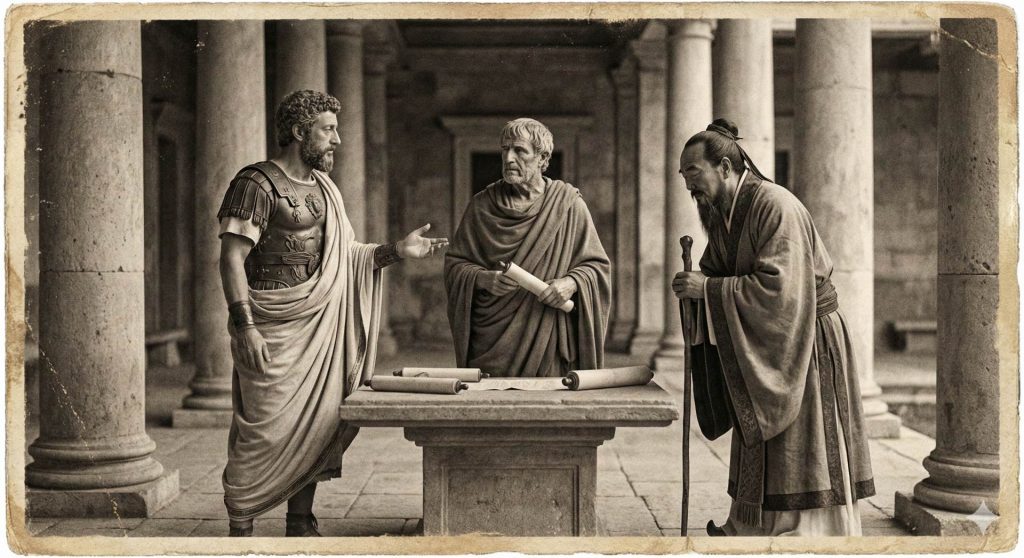
There’s a moment every leader dreads—when everything falls apart at once. The project fails. The team fractures. The market turns against you. In that moment, you face a choice: become either a cold machine or a helpless bystander.
But what if there was a third way?
After years of exploring both Stoic philosophy and Vajrayana Buddhism, I’ve discovered something remarkable: when combined correctly, these ancient traditions create what I call the “Master Protocol”—a three-layered approach that transforms crisis into clarity, and panic into purposeful action.
Let me show you how this works in the real world, and why it might be exactly what you need right now.
The Problem with Half-Measures
We’ve all met the Robotic Stoic—the leader who stays calm by shutting down completely. They practice detachment so well that they become detached from everyone, including themselves. Their team respects their composure but never feels truly led.
Then there’s the Passive Buddhist—the compassionate soul who absorbs everyone’s suffering but lacks the backbone to actually direct the ship. They’re beloved but ineffective, like a therapist captain on a sinking vessel.
Neither approach works alone because leadership isn’t just about emotional control or compassionate presence. It requires all three dimensions: the shield, the heart, and the engine. This is where the Master Protocol comes in.
Layer One: The Stoic Shield (Protecting the Body)
Picture this: Your business is hemorrhaging money. Clients are canceling contracts. Your team is looking at you with barely concealed terror. This is when you need the first layer—Stoicism—not as a philosophy to study, but as an immediate survival tool.
The ancient Stoics gave us the Dichotomy of Control, and it’s brutally practical. In the chaos, you perform a rapid triage: What can I control? What can’t I?
The market crash? External. Your competitor’s sudden advantage? External. But your racing heartbeat, your impulse to panic, your next decision—these are internal. They belong to you.
This isn’t about suppressing emotion. It’s about refusing to let external chaos commandeer your internal state. Marcus Aurelius called it building an “inner citadel”—a fortress that circumstances cannot breach.
The practice: When crisis hits, spend sixty seconds doing this mental sorting. Write it down if you must. “Market conditions = external. Team morale = external effect, but my response = internal.” This simple act creates what the Stoics called ataraxia—unshakability.
The result: Something remarkable happens. While everyone around you is drowning in reactive emotion, you remain still. Not cold—still. Like a mountain in a storm. This creates natural authority without you saying a single word. People unconsciously move toward stability.
But here’s the critical point: if you stop here, you become the Robotic Stoic. The shield alone makes you invulnerable but isolated. This is where most Western leaders fail. They think strength means staying behind the wall forever.
Layer Two: Tonglen (Opening the Heart)
Now comes the Buddhist secret weapon—tonglen, the practice of “sending and receiving.” This is where Vajrayana Buddhism reveals its sophisticated understanding of human psychology.
You’ve achieved calm through Stoicism. Now, instead of staying locked in your citadel, you deliberately open the gates. You look at your panicked team, and you do something counterintuitive: you breathe in their fear.
Yes, you read that right. Breathe it in.
The practice: As you inhale, visualize yourself drawing in the dark smoke of their anxiety, their blame, their exhaustion, their doubt. Let it pass through your Stoic inner citadel—the fortress remains standing, but you’ve opened the windows. As you exhale, send out relief, confidence, and grounded presence.
This sounds mystical, but it’s deeply practical. You’re essentially becoming what engineers call a “heat sink”—a stable system that absorbs thermal chaos and dissipates it safely. The team’s toxic emotional energy flows into your calm center and grounds there, preventing it from bouncing between people and amplifying.
The result: People feel it. They can’t explain it, but suddenly the room feels different. The panic subsides. Not because you’ve fixed the external problem yet, but because you’ve transformed the internal atmosphere. You’ve become a psychological anchor.
This is the missing piece that Stoicism alone cannot provide. Tonglen teaches you to be strong and connected, armored and accessible. You’re no longer the cold statue—you’re the warm mountain.
But we’re still not done. Because compassionate stability, while powerful, isn’t enough to solve the actual problem. This is where most Buddhist practitioners stop, achieving peace but not progress. We need the third layer.
Layer Three: Vajrayana Visualization (Igniting the Engine)
Here’s where Vajrayana Buddhism reveals its most potent teaching: creation stage practice and divine pride. Western minds often misunderstand this as mere positive thinking. It’s not. It’s far more sophisticated.
You’ve stabilized yourself (Stoic shield). You’ve stabilized the room (Tonglen heart). Now you use tantric visualization to create the future in present consciousness.
The practice: You don’t just hope for Q4 recovery. You don’t make a tepid vision board. You vividly visualize the successful outcome as a current reality. You see the team functioning smoothly, the clients returning, the metrics rising—not as a future fantasy but as a “pure land” that already exists in potential.
The Vajrayana term is “divine pride”—you embody the successful version of yourself now. You speak from that place. You make decisions from that place. You project this mandala of success onto everyone in the room.
The result: Something almost magical happens. Because you are genuinely calm (layer one) and they trust you (layer two), your visualization becomes contagious. The team begins operating from the successful future rather than the failing present. This is how Steve Jobs’s famous “reality distortion field” actually worked—it wasn’t delusion, it was Vajrayana technology wrapped in Silicon Valley packaging.
The Complete Protocol in Action
Let’s see all three layers working together in a real crisis:
Crisis hits. Your major client just canceled, taking 40% of revenue with them.
Layer One (60 seconds): You categorize. Client’s decision = external. Team’s fear = external. Your response = internal. You achieve stillness. Heart rate drops. You become the unshakable reference point.
Layer Two (2 minutes): In the emergency meeting, you look at each team member. You breathe in their panic. You let it pass harmlessly through your stable center. You breathe out grounded confidence. The room’s temperature changes. People sit up straighter.
Layer Three (5 minutes): Now you speak. But you’re not speaking from the crisis. You’re speaking from the already-successful future. You vividly describe the new clients you’ll land, the improved systems you’ll build, the stronger company that emerges. You embody this so completely that everyone else begins to see it too.
The crisis hasn’t changed. But everything else has.
Your Practice Starts Now
This isn’t theory—it’s a protocol you can implement immediately:
Today: Practice the Stoic sorting. Next time stress hits, spend one minute categorizing internal versus external. Notice how this alone reduces anxiety by half.
This week: Add tonglen. In your next difficult conversation, consciously breathe in the other person’s stress and breathe out calm. Watch what happens to the dynamic.
This month: Begin visualization practice. Spend five minutes daily vividly experiencing your successful future as present reality. Embody that version of yourself in one meeting.
The beauty of the Master Protocol is that each layer makes the next one possible. The Stoic shield gives you the stability to practice tonglen without being overwhelmed. Tonglen gives you the connection to make your visualization contagious rather than delusional.
Together, they solve the impossible problem: how to be simultaneously strong and compassionate, detached and engaged, realistic and visionary.
The ancient masters knew this. Now you do too.
The question is: what will you do with it?