
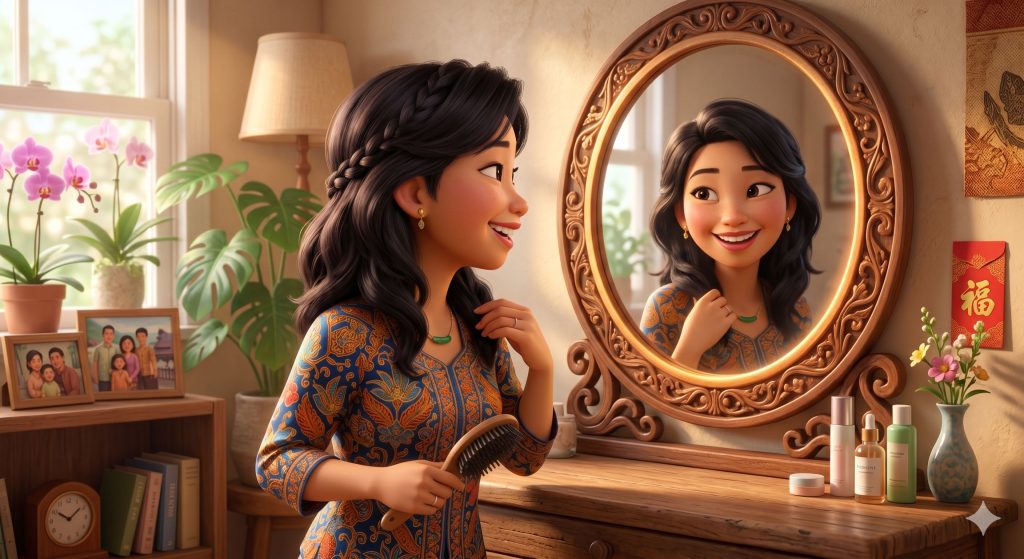
Maya Santoso was twenty-six, gainfully employed as a junior graphic designer in Surabaya, and the undisputed world champion of finding things wrong with her own face.
Every morning began the same way. She’d walk into the bathroom, flick on the lights, and lean toward the mirror like a detective examining a crime scene. Okay. Let’s see what’s terrible today.
Left eyebrow? Slightly less arched than the right. Criminal.
Right eyelash? Clumped together like wet spiders. Unacceptable.
Skin? One tiny bump near her chin that absolutely nobody else could see unless they pressed a magnifying glass against her face while squinting.
She’d spend fifteen minutes fixing, blending, reapplying, and then—just as she was about to leave—she’d lean back in and whisper, “Should I add more mascara?”
Spoiler: she always added more mascara.
Maya believed, with the same intensity that some people believed in gravity, that a woman’s look was her primary currency. Attraction was power. Power got you money, attention, and—most importantly—a smooth life. Her mother had told her this. Her aunties had told her this. Even the women’s magazines at the dentist’s office seemed to whisper it: Nobody knows your heart at first glance, honey. But they sure notice your lipstick.
So Maya built her entire self-worth on how well she performed “attractive.” And for a while, it worked. She got free drinks. She got job interviews where the manager smiled a little too easily. She got a boyfriend named Andi who told her she was beautiful exactly three times a week (Monday, Wednesday, Friday, like a subscription service).
But then something terrible happened.
Younger women started appearing everywhere.
At Tunjungan Plaza, twenty-year-olds glided past in cropped tops and perfect skin, looking like they’d never eaten a single carb in their entire lives. At her workplace, a new intern named Sari showed up with cheekbones that could cut glass and a laugh so carefree it made Maya want to throw her concealer into the sun. At community gatherings, there was always someone—younger, fresher, somehow more symmetrical.
Maya started questioning. How attractive am I now? Compared to her? Compared to her? Compared to that random stranger on Instagram who just posted a selfie with perfect lighting?
She returned to the mirror. But now, instead of a quick check, she studied. And the more she studied, the more faults she found.
Her nose was too wide. Her chin was too soft. Her smile was crooked on the left side. Her forehead had a line that wasn’t there last month, or maybe it was, and she’d just never noticed, and now she couldn’t unsee it, and oh God, was that a gray hair?
Her self-esteem dropped faster than a stolen phone down a toilet bowl. Her confidence evaporated like morning dew in a Surabaya heatwave.
People started noticing. During meetings, her voice developed a slight stutter—not a cute one, the kind where people lean in and go, “Are you okay?” Her hands trembled when she held a coffee cup, which made her spill coffee on her blouse, which made her feel even worse. She shifted uncomfortably in her chair, crossed and uncrossed her legs, touched her hair approximately nine hundred times per conversation.
People felt awkward around her. They’d glance at each other, give tight smiles, and slowly back away like she was a slightly unstable microwave.
Her life began crumbling.
At home, her boyfriend Andi—the same Andi who used to call her beautiful on a strict Monday-Wednesday-Friday schedule—started picking fights. “Why are you always staring at your phone? Why do you take forty minutes to get ready? Why did you cry because the fried rice came in a bowl instead of a plate?” (That last one was a low point, she’d admit.)
She fought back. Then cried. Then fought about crying. Then cried about fighting. It was exhausting for everyone involved, including Mochi the cat (yes, Mochi made a cameo, because every good Indonesian story needs a judgmental cat).
One particularly awful Tuesday, after a fight about nothing (the toothpaste cap, if you can believe it), Maya sat on her bedroom floor surrounded by crumpled tissues and three empty cups of instant noodles. She felt hollow. Like someone had scooped out her insides and replaced them with wet cardboard.
Her phone buzzed. A message from her college friend, Lina.
“Hey. I know you’ve been weird lately. Come to this thing with me tomorrow night. It’s a Toastmasters meeting in Surabaya. Public speaking stuff. But also… just come. Trust me.”
Maya almost said no. But then she looked in the mirror—her hair was a mess, her eyes were puffy, and she thought, Well. Can’t get much worse.
So she went.
The meeting was held in a modest community hall near the river, with plastic chairs, a whiteboard covered in motivational quotes, and a fan that sounded like a dying helicopter. About twenty people sat in a loose circle. At the front, three older individuals occupied chairs like they owned the place—not because they were arrogant, but because they’d probably been sitting there since the Clinton administration.
Lina whispered, “Those three? They call themselves ‘The Three People Who Don’t Always Get Along.'”
Maya raised an eyebrow. “That’s… a mouthful.”
“They argue all the time. Seriously. Last week they spent twenty minutes debating whether ‘um’ counts as a word. But they trust each other with their backs. Weird, right?”
The three were:
- Pak Budi, a retired engineer with eyebrows so thick they looked like angry caterpillars. He spoke slowly, as if each word cost him money.
- Ibu Ratna, a former school teacher who laughed like a deflating balloon and had zero tolerance for nonsense. She once made a grown man cry by saying, “Your grammar is a war crime.”
- Tan Siong, a soft-spoken Chinese Indonesian uncle who ran a small tofu shop and had the calmest energy Maya had ever encountered. He nodded along to everything like he already knew the ending.
They argued within the first five minutes.
Pak Budi: “The agenda says we start with jokes. I don’t have a joke.”
Ibu Ratna: “Then tell a fact. Facts are just boring jokes.”
Tan Siong: “A man walked into a tofu shop—”
Pak Budi: “That’s not a joke, that’s just a Tuesday for you.”
Tan Siong: “Exactly.”
Everyone laughed. Maya found herself smiling. It was weird. These three clearly disagreed about everything, but there was something solid underneath. Something warm.
During the break, Tan Siong approached her. He didn’t ask why she looked nervous or why her hands were trembling. He just handed her a cup of tea and said, “You look like someone who’s been fighting a war alone.”
Maya’s throat tightened. “Something like that.”
“We have a saying here,” Tan Siong continued. “People don’t get energy just from food. They also get it from the positive feelings that radiate from other people. That’s why we built this club. To radiate. To attract people to a helpful, caring atmosphere. Some clubs claim to be the best. We just claim to be the warmest club under the heaven.”
Maya blinked. “That’s… surprisingly humble for a claim like that.”
“We’re humble because we argue too much to be arrogant.” He smiled. “Join us. I’ll mentor you. One session. If you hate it, you can leave and never come back. I’ll even pretend I don’t recognize you at the supermarket.”
She joined.
The mentoring session happened on a Saturday morning, in the back room of Tan Siong’s tofu shop. The smell of fermented soybeans filled the air. It was not a glamorous location, but Maya figured her current life wasn’t exactly a Netflix rom-com either.
She sat across from Tan Siong, who was calmly pressing tofu with the same expression a monk might use while meditating.
“I need to build confidence,” Maya blurted out. “My stutter is getting worse. My hands shake. I can’t even look at my own reflection without finding seventeen things wrong with my face. How do I fix this?”
Tan Siong set down his tofu press. He looked at her for a long moment, then said something that sounded almost insultingly simple.
“It’s easy. Love yourself first.”
Maya stared. “That’s it? That’s the advice? Love yourself? I’ve seen that on a coffee mug, Pak.”
He chuckled. “Let me finish. Every morning, look in the mirror. But not to find fault. Smile at your face. Your eyes. Your hair. Every single thing you see. And here’s the important part—feel gratitude to them.”
“Gratitude? To my eyebrow?”
“Yes. To your eyebrow. To your nose. To the tiny lines around your mouth that prove you’ve laughed at stupid jokes. To the millions of living cells that woke up this morning and decided to keep you alive for another day. Send them gratitude. They are working for you, not against you.”
Maya opened her mouth to argue. Then closed it.
“When you send gratitude,” Tan Siong continued, “you will radiate an inner glow. Not makeup glow. Not filter glow. Real glow. People will feel it. They won’t know why, but they’ll want to be near you. Slowly, surely, you’ll notice how people enjoy being with you. And that… that brings confidence. Real confidence. The kind that doesn’t disappear when your mascara smudges.”
The words hit Maya like a thundering voice inside her skull.
She had spent years looking in the mirror to find fault. Every morning, she walked to that bathroom with a mental checklist of everything wrong. And every morning, she found plenty. She had turned her own reflection into an enemy, a courtroom judge, a firing squad.
But what if… what if she looked to say thank you instead?
What if her face wasn’t a problem to be solved, but a team to be cheered?
She sat in that tofu shop for a long time, smelling soybeans and feeling something crack open in her chest. Not painfully. More like a window that had been stuck for years, suddenly sliding open to let in fresh air.
The next morning, Maya walked to the bathroom. She flicked on the lights. She looked at the mirror.
Her left eyebrow was still slightly less arched than the right.
She smiled.
“Thank you for trying your best, left eyebrow. I know arching isn’t easy.”
She looked at her right eyelash.
“Thank you for not clumping today. That was a nice surprise.”
She looked at her skin, her nose, her chin, her forehead. She even thanked the tiny bump near her chin, which she decided to name Kevin.
“Thank you, Kevin, for being small and mostly harmless.”
It felt ridiculous. Absolutely, utterly ridiculous. She almost laughed at herself.
But then something strange happened. Her shoulders relaxed. Her breathing slowed. And when she walked out of the bathroom, she didn’t immediately check her phone to see if anyone had posted a prettier photo.
She made coffee. She pet Mochi (who accepted the attention with royal indifference). And she went to work.
Her voice still stuttered a little. Her hands still trembled a little. But less. Like a radio station that was slowly tuning out the static.
That night, Andi came home. He looked at her. She looked at him.
“You seem… different,” he said cautiously, like a man who had been burned by the “different” comment before.
“I’m trying something,” Maya said. “Loving myself. Or whatever. It’s weird.”
Andi blinked. “Is that why you haven’t yelled at me about the dishes?”
“The dishes are still there, Andi. I just decided they’re not worth a fight.”
He sat down next to her. They didn’t solve everything. But they didn’t fight either. They just sat. And for the first time in months, the silence didn’t feel like a bomb waiting to explode.
Maya thought about Tan Siong’s words. About the warmest club under the heaven. About gratitude and inner glow and millions of tiny cells working together to keep her alive.
She wasn’t confident yet. Not really. But she had stopped looking for faults.
And that, she realized, was a damn good start.
The next morning, she looked in the mirror again.
“Good morning, face. Let’s try this again.”
Kevin the chin bump winked back. Probably.