
What did the Buddha say about ending our suffering? How do we overcome modern-day pressure, stress, and frustration?
I know for certain that if left untreated, stress and depression can cause severe health issues sooner or later. It is not a question of if, but when. Someone once asked me: what is the actual relationship between stress and physical health?
Even though I believe mental stress can lead to severe illnesses like cancer and immune disorders, a friend of mine who works as a health professional insists that science doesn’t pinpoint stress as the direct cause. He argued that many people live under constant stress without contracting a serious illness before they die. Conversely, some happy people who live well suddenly face severe health diagnoses out of nowhere. It is a valid point: without isolated data proving a direct cause, we cannot definitively claim a simple cause-and-effect relationship.
However, I once read a news story about a seemingly peaceful neighborhood that was suddenly thrown into commotion. A resident tried to end their life by refusing to eat for a week because they had lost all hope. Fortunately, a curious neighbor checked on them and saved their life just in time.
That story taught me a valuable lesson: even if a mental health crisis does not cause an immediate physical illness, it creates an environment ripe for bad things to happen. Imagine living in a neighborhood where no one cares about sanitation and garbage is thrown everywhere. You might survive through ignorance, and you won’t know who gets sick first, but you can be certain that health problems will eventually arrive.
Even a healthy environment can hide underlying problems before they explode. Life is always in motion, and none of us know when bad news will arrive. Just like cells in our body, each of us has a different capacity for pressure—some cells are tough, while others give up after a few adverse conditions.
Therefore, it is imperative to manage our mental health early, before it manifests into something ugly.
Fortunately, we do not need to leave everything behind. Siddhartha Gautama, the Buddha, left his kingdom and family to find answers because his circumstances were different—there were few teachers available, and the prevailing knowledge was unsatisfactory. In contrast, we live in a world where information is at our fingertips. We can even use AI to explore solutions instantly. There is no need to abandon your life just to find inner peace.
If you wonder how I handle daily stress and protect my mental health, here is the three-step practice I use:
- Step 1: Awareness Meditation. In the morning, I practice awareness meditation to regain control over my emotions. I often use yoga exercises or Qigong as physical anchors for this practice.
- Step 2: Emotion Redirection. Emotions are like a surging river—they cannot simply be blocked. The best approach is diversion. Once awareness gives me control, I redirect my energy toward compassion and generosity. I volunteer in my local community, donate, or simply listen to someone who needs a ear. If I cannot do those, I sit down and practice Tonglen meditation or pray for others’ safety and health. It works just as effectively.
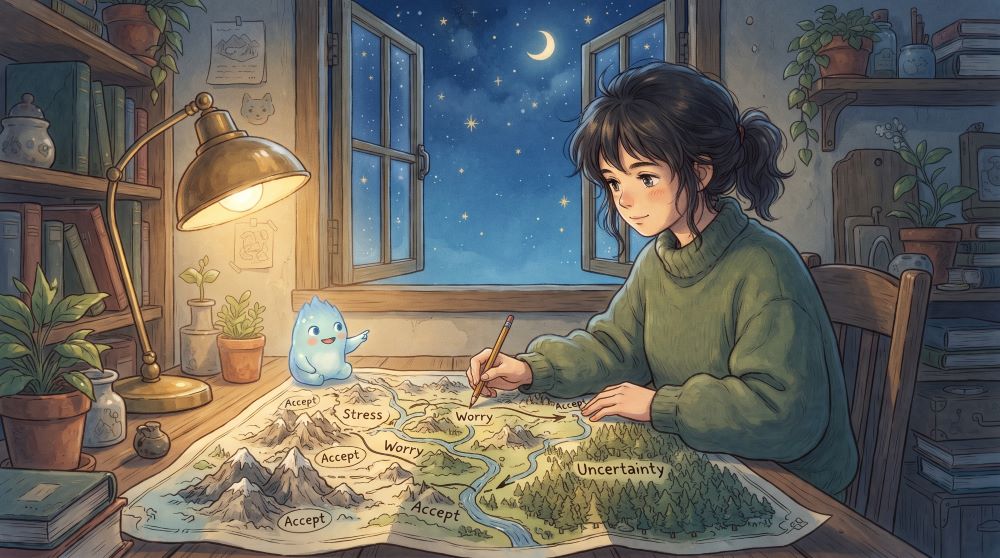
- Step 3: Problem Mapping. Once my emotions are redirected and I am calm, I map out my problems. I identify their root causes, figure out practical solutions, or ask for guidance from people who know how to handle them. If a problem has no solution, I practice accepting the situation and learning to live with it.
These three steps helped me overcome depression and rebuild my life. If this exact structure doesn’t suit you, there is no need to worry. What matters most is finding a teaching that resonates with you, a supportive community, and a mentor who has walked the path before you.