“I must not fear. Fear is the mind-killer. Fear is the little-death that brings total obliteration. I will face my fear. I will permit it to pass over me and through me. And when it has gone past, I will turn the inner eye to see its path. Where the fear has gone, there will be nothing. Only I will remain.” — Frank Herbert, Dune
I have always been full of fear and worry; they have been my companions since I first began to consider the future implications of unfavorable events. People often say, “ignorance is bliss.” I cannot deny that it is true—there is nothing to worry about if you do not anticipate what lies ahead. You simply go about your day, and when unfavorable outcomes show their ugly face, you accept reality and move forward with whatever you have left. It seems like a simple way of living.
However, the human mind is not built for such simplicity. Evolution has wired us to learn from past mistakes, allowing us to retain memories of traumatic events while imagining future scenarios based on our choices.
Consequently, fear and its sister, worry, often accompany us during our darkest moments. At its peak, fear paralyzes our capacity to react effectively, preventing us from performing at our best.
For a long time, fear was my primary driving force. It can be a powerful motivator to squeeze every ounce of effort from your body and mind to achieve great results. But at what cost?
According to Five Elements theory in Taoist philosophy, fear is the negative emotion associated with the kidneys. Remaining in a constant state of fear floods the body with stress hormones, which can gradually damage overall health:
- Vasoconstriction: Adrenaline constricts blood vessels during sustained stress, reducing blood flow to the kidneys over time.
- Elevated Blood Pressure: Stress triggers hormones like cortisol and renin, leading to salt and water retention that increases blood pressure—a major risk factor for organ damage.
- Chronic Inflammation: Prolonged stress dysregulates immune signaling, heightening persistent inflammatory pathways in the body.
Beside the physical toll, what real achievement comes from acting out of fear? I used to draw my determination entirely from fear—using it to wake up early and push through long workdays by reminding myself of the worst-case scenarios.
With fear as my boss, I became a hardworking person, but an unhappy one. Where did that lead? It made me a dutiful worker, but I never achieved anything extraordinary. Whenever a situation called for creativity, risk-taking, or collaboration, my reactive mindset deterred others from connecting with my ideas. My output lacked finesse because I was constantly operating from stress rather than enjoyment.
When I started my own business, I worked entirely alone. Collaborators felt uncomfortable around my reactive mindset and tense energy. I was simply unable to enjoy moments of peace.
Eventually, I discovered Inner Smile meditation. Although the practice is straightforward—focusing a gentle smile inward toward your internal organs—it created a significant shift in how I projected myself to the world. As I practiced smiling down to my kidneys, my body relaxed, and my chronic anxiety began to ease. At first, I was confused: how could a relaxed attitude drive success without the familiar pressure of intense ambition?
What kept me practicing was the realization that decades of fear-driven hustle had yielded nothing noteworthy. If I wanted to learn how to collaborate effectively with others, I needed to source my energy from balanced, healthy emotions. Furthermore, my body was sending clear warning signs—fatigue, frequent headaches, and heartburn—that pointed toward developing hypertension.
I had every reason to let go of fear. The question remained: how could I motivate myself without relying on worry as my primary engine?
The answer came unexpectedly while watching speeches by leaders like John F. Kennedy, Lee Kuan Yew, and Barack Obama. They moved people not through intimidation, but through compelling visions grounded in care for their communities.
I realized there was another path to achievement: motivating myself and others through shared purpose and genuine care. Unlike fear, this form of energy does not tear down your physical health. At its best, vision unites people of all backgrounds to solve complex problems together.
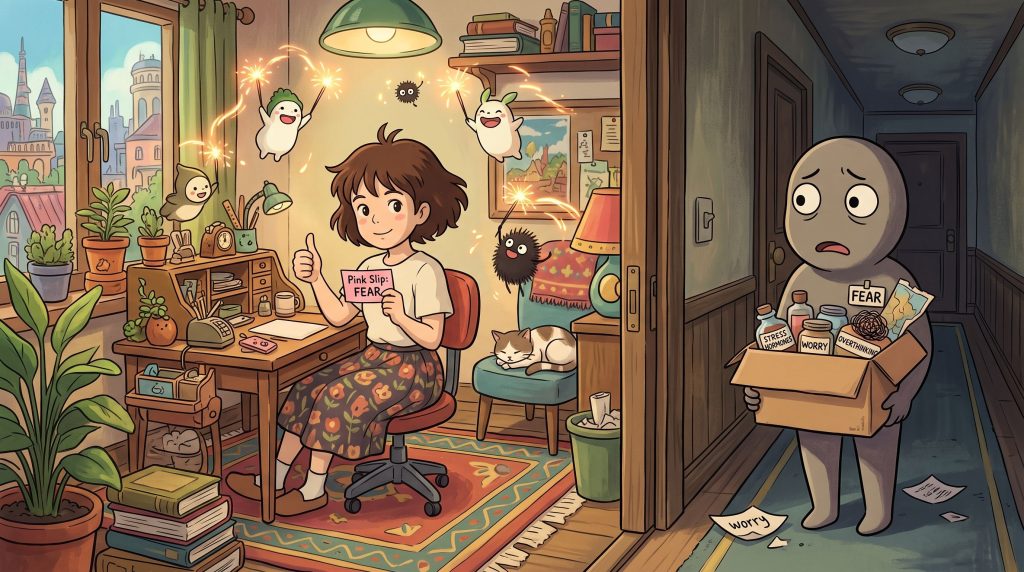
Stepping away from fear-based motivation has been quite a learning curve, but it transformed my journey completely. Fear and worry can serve as helpful signals to alert us to danger, but they make terrible long-term bosses.
Do you still want to live and work in fear?