We often encounter a common mental block: the idea that discipline is a cage. We see the rigid schedules, the early morning exercises, and the endless hours of study as a form of self-imposed imprisonment. We crave the “flow,” but we mistake laziness for freedom.
This is the story of Adrian, a young man who had to lose everything to realize that the walls he thought were trapping him were actually the foundation of his future.
The Illusion of the Prison
At twenty-one, Adrian felt like a bird in a very small, very dull cage. His life was a monotonous loop of “shoulds.” He should be studying for his engineering degree. He should be at the gym, pushing weights until his muscles screamed. He should be practicing his Japanese kanji.
To Adrian, the ticking of the clock was a countdown of lost youth. He looked out his window at the neon lights of the city and felt a profound sense of FOMO—Fear Of Missing Out. While he was memorizing formulas, his friends were at the new rooftop lounge. While he was meal-prepping chicken and broccoli, they were discovering the best late-night street food.
One Tuesday evening, halfway through a complex chapter on thermodynamics, Adrian snapped. He slammed the textbook shut.
“I’m done,” he whispered to the empty room. “I’m tired of living for a ‘future’ that never seems to arrive. I want to live now.”
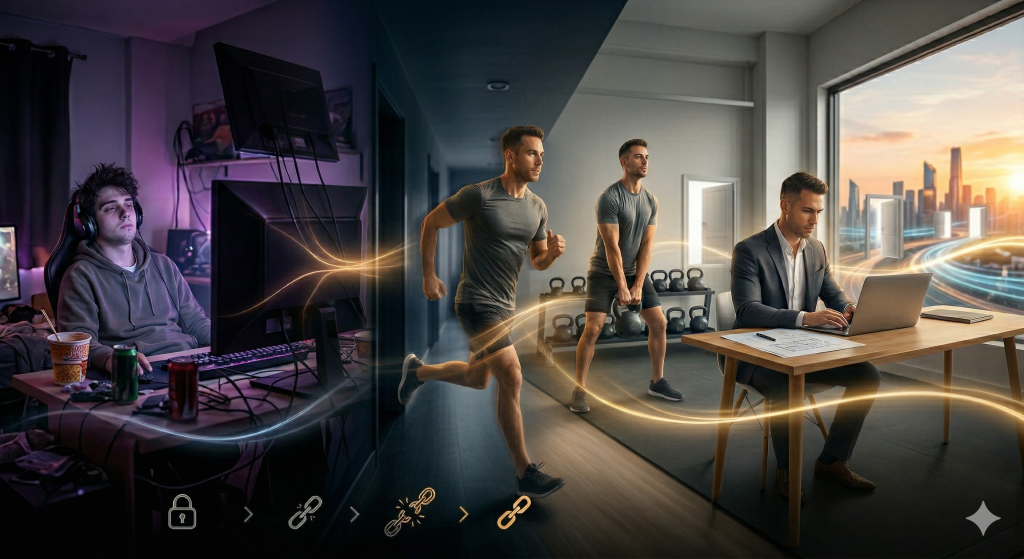
That night, he didn’t go to the gym. He didn’t finish the chapter. Instead, he called his friends, headed to an internet cafe, and spent eight hours lost in a digital world where he was a high-ranking warrior. The dopamine hit was immediate and intoxicating. For the first time in years, he felt “free.”
The Five-Year Drift
The next five years were a blur of comfortable stagnation. Adrian did just enough to stay afloat, working a dead-end data entry job that required zero effort. His nights were dedicated to gaming and his weekends to “hanging out”—a term that mostly involved sitting in cafes, complaining about the economy, and scrolling through social media.
He felt he was living the dream of the liberated man. He had no schedules, no grueling workouts, and no demanding intellectual pursuits. But if he were honest with himself during those quiet moments at 3:00 AM when the monitor went dark, he would have noticed that his world was actually shrinking.
His body had grown soft and sluggish. His mind, once sharp enough to tackle complex physics, now struggled to focus on a long-form article. Most importantly, his options were disappearing. He couldn’t apply for better jobs because he hadn’t kept up with his skills. He couldn’t travel because his salary barely covered his gaming subscriptions and lattes. He was “free” to do nothing, and he was doing it perfectly.
The Mirror of Rejection
The wake-up call came in the form of Elena.
Elena was a woman Adrian had known since college. She was bright, energetic, and possessed a natural “glow” that Adrian found irresistible. They had been casually seeing each other for a few months, and Adrian was ready to take things seriously. He imagined they would spend their weekends the way he liked—relaxing, watching movies, and letting life happen.
One evening, over a mediocre dinner, Adrian asked her where she saw “them” going.
Elena looked at him with a mixture of kindness and painful honesty. “Adrian, I like you. You’re funny and kind. But I can’t see a future here.”
“Why?” Adrian asked, his heart sinking. “Is it because I don’t make enough money?”
“It’s not the money,” Elena sighed. “It’s the energy. I’m moving forward, Adrian. I’m starting my own consultancy, I’m training for a marathon, I’m learning every day. When I look at you, I see someone who is standing still. You’re waiting for life to give you something, but you aren’t building anything to hold it in.”
A few weeks later, Adrian saw her on social media with a man named Marcus. Marcus wasn’t just wealthy; he radiated a different kind of presence. In the photos, you could see the discipline in his posture and the clarity in his eyes. He was a man who clearly woke up with a purpose.
The realization hit Adrian like a physical blow. He hadn’t chosen “freedom” five years ago; he had chosen impotence. By abandoning his routines, he had stripped himself of the power to compete, the power to provide, and the power to choose the life he wanted. He wasn’t free; he was a hostage to his own comfort.
The Return to the Body
The first thing Adrian did when he got home that night was delete every game on his hard drive. The second thing he did was look in the mirror.
He saw a man who looked older than his years, with slumped shoulders and a dull complexion. He remembered a principle he had once dismissed: A successful career and a flowing life start with a healthy body. If the vessel is cracked, it cannot hold the light of success.
The next morning at 5:00 AM, the “prison” doors reopened.
The first month was agony. His body protested every mile he ran. His brain screamed for the easy dopamine of a video game. But this time, Adrian’s perspective had shifted. He no longer saw the sweat and the struggle as a punishment. He saw it as capital. Every push-up was a deposit into a bank account of personal power.
He focused on his physical health with the intensity of a man reclaiming his soul. As his strength returned, so did his mental clarity. He realized that the “sluggishness” he felt for five years wasn’t just physical; it was a blockage of his vital energy—his Qi. By moving his body, he was unblocking his life.
The Flow of Mastery
Once his physical foundation was set, Adrian turned his attention to his mind. He realized that in the modern world, “options” are synonymous with “skills.” He began to stack skills like bricks. He returned to his engineering roots but added data science and project management to the mix.
He stopped “hanging out” and started “networking.” He sought out mentors—men and women who viewed discipline not as a burden, but as a refined tool.
Five years after his rejection, Adrian’s life didn’t just look different; it felt different. He was now a senior consultant at a renewable energy firm. He moved with a grace and confidence that drew people to him. He didn’t have to chase opportunities; they seemed to flow toward him because he had built the capacity to handle them.
He realized the great paradox of life: The more disciplined you are with your routine, the more freedom you have in your results. Because he was disciplined with his fitness, he had the energy to work twelve-hour days when a big project arrived. Because he was disciplined with his finances, he had the freedom to invest in a business he believed in. Because he was disciplined with his mind, he had the wisdom to choose a partner who truly aligned with his soul.
Discipline was never a prison. It was the blueprint for the palace he now lived in.
He often thought back to his twenty-one-year-old self, sitting in that dark room, thinking he was free. He wished he could tell that boy that true freedom isn’t the absence of structure; it’s the mastery of it.
As the late, great business philosopher Jim Rohn once said:
“We must all suffer one of two pains: the pain of discipline or the pain of regret. The difference is discipline weighs ounces while regret weighs tons.”